
How Electrical Switchboards Support Industrial Electrical Systems
The line stops.
Not gradually. Not politely. Just—stops.
Conveyors freeze mid-motion. Motors wind down. Overhead lights hum louder in the sudden quiet. Somewhere in the building, a breaker has tripped.
And in that silence, everyone turns toward the electrical room.
Because behind that locked metal door lives the system that keeps everything alive: electrical switchboards.
They don’t move product. It doesn’t weld steel. They don’t assemble parts.
But without them? Nothing moves at all.
Table of Contents
The Power Traffic Controller
Industrial facilities don’t sip electricity. They gulp it.
Incoming power from the utility or transformer hits the switchboard first. From there, it’s distributed—carefully—to production lines, HVAC systems, lighting grids, heavy equipment, and specialized machinery.
This isn’t random flow.
Electrical switchboards organize and divide high-capacity power into manageable, protected circuits. Think of them as air traffic control for current—directing flow, preventing collisions, and keeping everything on schedule.
Without structured distribution? Overloads happen fast.
And in industrial settings, overloads are expensive.
Heavy Loads. Zero Room for Error.
Let’s talk demand.
Industrial motors, welders, compressors, data centers—these systems pull serious amperage. If too much current flows unchecked, wires overheat. Equipment fails. Fires start.
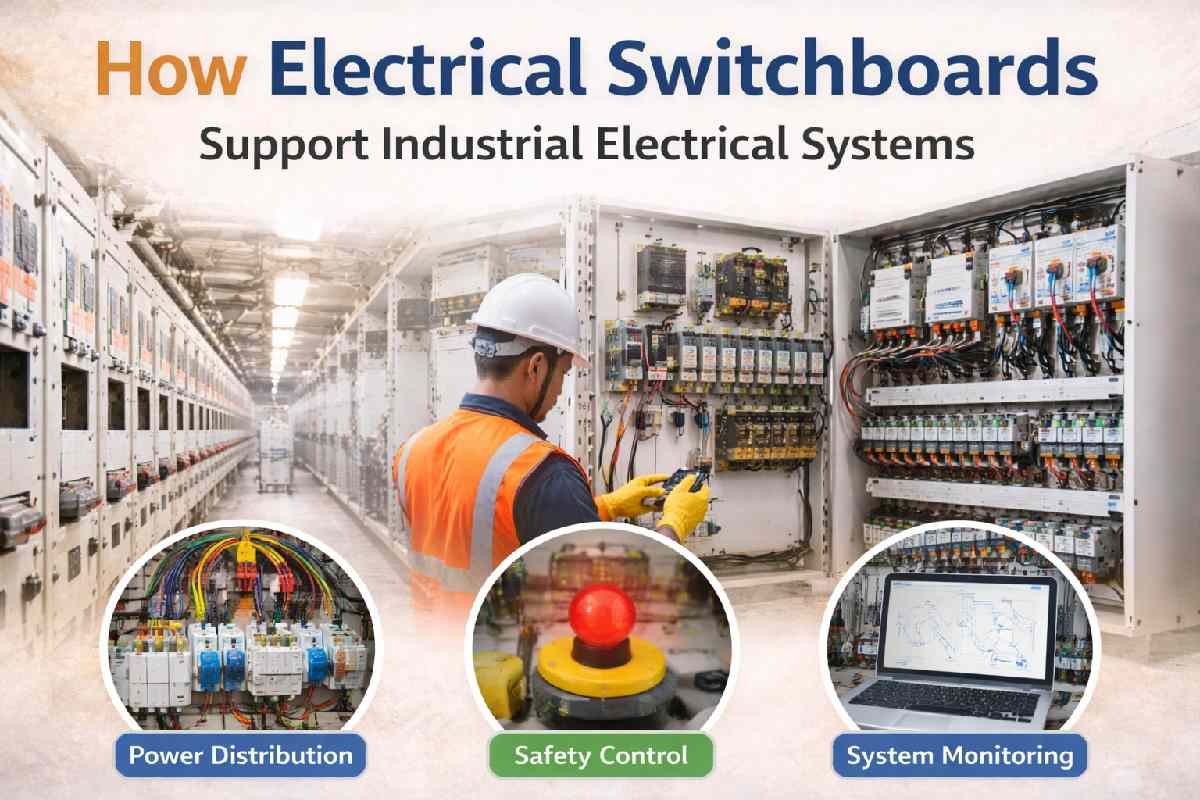
Switchboards prevent that by housing:
- Main disconnect switches
- Circuit breakers
- Protective relays
- Bus bars for structured distribution
When something goes wrong—a short circuit, a fault, an overload—the breaker trips.
Instantly.
That interruption isn’t a nuisance. It’s protection.
And here’s where quality matters. Reliable breakers sourced from trusted suppliers like Verified Breakers ensure consistent performance under extreme load conditions. In industrial environments, components must trip precisely when needed—no hesitation, no failure.
Because milliseconds matter.
Selective Shutdown: The Productivity Saver
Imagine shutting down an entire manufacturing plant because one circuit failed.
That’s not strategy. That’s disaster.
Electrical switchboards allow selective isolation. If one area experiences a fault, operators can shut down that section while the rest of the facility keeps running.
Maintenance crews work safely. Production continues elsewhere.
Downtime stays contained.
That’s not just convenience—that’s operational resilience.
Scalability: Built for Growth
Industrial operations evolve.
New machinery. Expanded lines. Automation upgrades. Additional energy demands.
A properly designed switchboard anticipates growth. Additional circuits can be integrated. Capacity can be expanded—if planned correctly from the beginning.
Short-sighted design forces expensive retrofits.
Forward-thinking infrastructure? It adapts.
Electrical switchboards aren’t static metal boxes. They’re strategic assets.
Monitoring: The Early Warning System
Modern industrial switchboards often integrate monitoring capabilities.
Voltage levels. Current flow. Power factor. System irregularities.
This data isn’t just technical noise—it’s insight.
Spotting an imbalance early can prevent equipment damage. Identifying unusual load patterns can signal mechanical issues before they escalate.
Proactive detection beats reactive repair.
Every time.
Compliance Isn’t Optional
Industrial electrical systems operate under strict regulatory standards.
Grounding. Breaker sizing. Clearances. Enclosure ratings.
Switchboards must meet these codes—not just for inspection, but for safety.
Using high-quality, compliant components—like those available through Verified Breakers—supports both operational integrity and regulatory confidence.
Cut corners here, and you pay later.
The Quiet Backbone of Everything
Here’s the irony:
When electrical switchboards work perfectly, nobody notices them.
They don’t get celebrated. It doesn’t get discussed in production meetings. They don’t appear in marketing materials.
But when they fail?
Everything stops.
Machines freeze. Output drops. Revenue pauses.
Switchboards are the unsung backbone of industrial electrical systems—managing load, isolating faults, protecting equipment, and enabling growth.
They quietly coordinate enormous power so that everything else can move loudly.
And in an industrial setting, that kind of quiet reliability is exactly what keeps the world running.