
From Radio to Reels: A Short History of How India Followed Cricket
Ask three generations of an Indian family about the first match they remember and you will probably get three very different answers.
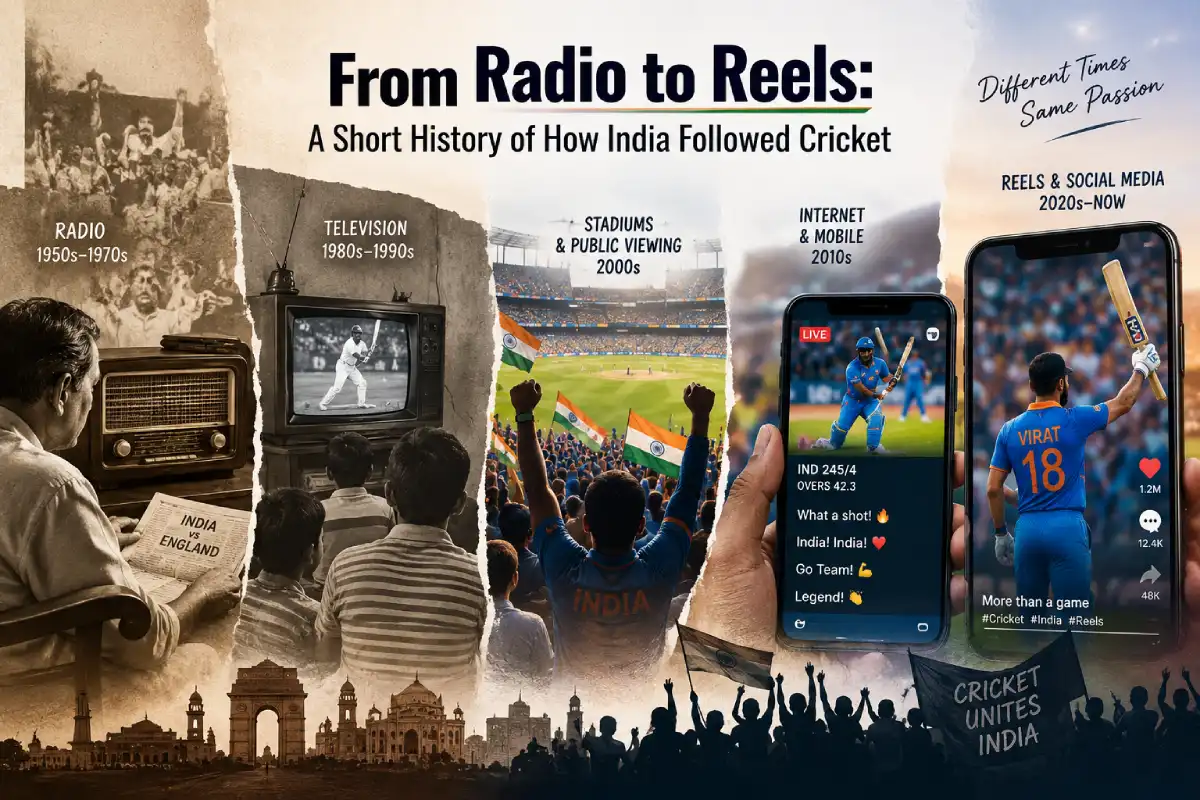
A grandparent might describe crowding around a transistor radio, straining to hear a commentator’s voice crackle through static from a ground a thousand kilometres away. A parent might remember a neighbour’s television in the 1980s, with half the street squeezed into one living room. A teenager today will describe a phone screen, a stream, a group chat and a feed of clips arriving faster than the replays.
The way India follows cricket has changed almost beyond recognition in a single lifetime. Each change did more than make matches easier to watch. It reshaped who watched, how they talked about the game and where the money came from.
Table of Contents
The Radio Years
For decades, cricket in India was something you listened to.
All India Radio carried commentary in English and, over time, in Hindi, and the arrival of cheap transistor radios put that commentary into shops, offices, tea stalls and village squares. Commentators had to paint the whole picture with their voices: the field placings, the bowler’s run-up, the shape of a cover drive. The best of them became household names in their own right.
Radio built a particular kind of fandom. It was shared and public. A single set at a paan shop could gather a crowd of strangers, and news of a wicket travelled outward from that crowd by word of mouth. It also meant most people formed their picture of great players without ever seeing them bat.
Newsprint, Magazines and Posters
Radio told you what was happening. The printed page told you what it meant.
For many fans, the morning newspaper was where a match was truly digested. Scorecards ran in tiny print, and people studied them closely: who batted how long, who bowled how many overs, how the partnerships built. A detailed report from a correspondent at the ground filled in what radio had left out.
Sports magazines added another layer. Publications such as Sportstar, launched in 1978, carried long features, statistics and, crucially, colour photographs. For a generation of fans, those pages were the first place they saw their heroes in action rather than just heard about them. Posters pulled from magazines went up on bedroom walls across the country.
The printed era also shaped how fans argued. Without replays, debates about a decision or a dismissal depended on reports and memory, and a well-read fan with a good grasp of the statistics could win almost any dispute at the tea stall.
Television Arrives
Television changed everything, though more slowly than people remember.
Doordarshan’s national reach expanded rapidly in the early 1980s, and colour broadcasting arrived in 1982 around the Asian Games in Delhi. When India won the World Cup in 1983, the victory reached homes through a mix of radio and a still-growing number of television sets. It became the moment that turned cricket from a popular sport into a national obsession.
The 1987 World Cup, co-hosted by India and Pakistan, brought the tournament to the subcontinent for the first time. Television audiences grew, advertising around matches became more valuable, and cricket began its long transformation from a game into an industry.
For fans, television added pictures to the story that radio had told. Players became faces, not just names. Slow-motion replays appeared. And families gathered around a single set in a way that became a defining ritual of Indian cricket watching.
The Satellite Revolution
The early 1990s brought economic liberalisation, and with it came satellite and cable television. New private channels arrived, and suddenly Doordarshan was no longer the only way to watch.
A turning point came in 1995, when the Supreme Court ruled that the airwaves were public property rather than a government monopoly, a decision that arose from a dispute over broadcasting cricket. It opened the way for cricket boards to sell television rights in a competitive market.
The 1996 World Cup, again hosted in the subcontinent, showed what that market could do. Broadcast and sponsorship deals reached levels the sport had never seen, and cricket’s commercial centre of gravity began shifting firmly towards India. Coverage improved dramatically too, with more cameras, better graphics and expert analysis between overs.
Scores on the Internet and in Your Pocket
The internet reached cricket fans in stages.
Cricinfo began in 1993 as a volunteer effort to share scores and commentary online, largely for fans living abroad who couldn’t follow matches at home. By the late 1990s, ball-by-ball text commentary on the web had become a lifeline for office workers who kept a browser tab quietly open all afternoon.
Then came mobile phones. Through the 2000s, SMS score alerts turned every phone into a scoreboard. A single message with the score and the last wicket was enough to spread news through a workplace in minutes. Missed calls and texts became part of the language of following a chase.
The T20 Era and the IPL
India’s victory in the first T20 World Cup in 2007 arrived at exactly the right moment. A few months later, in 2008, the Indian Premier League launched and fused cricket with entertainment in a way the sport had never tried before.
The IPL was built for television from the start: short matches in prime time, a steady rhythm of breaks for advertising, and franchises with brands to build. It was also early to embrace the internet, streaming matches on YouTube in 2010 at a time when most sports were still wary of putting live coverage online.
Cheap Data Changes the Audience
The next shift came from mobile data rather than from cricket itself.
Streaming services such as Hotstar, launched in 2015, made live cricket available on phones. But the real turning point was the dramatic fall in mobile data prices after Reliance Jio launched in 2016. Almost overnight, watching a full match on a phone became affordable for tens of millions of people who had never owned a television of their own.
That changed who the audience was. Cricket reached younger viewers, migrant workers far from home, and people in smaller towns watching on their own schedules. In 2023, JioCinema streamed the IPL free of charge and reported record digital audiences. Two years later, following the merger of Reliance’s Viacom18 with Disney’s Star India business, the league moved to the combined JioHotstar platform.
The Layer Around the Match
Modern fandom no longer stops at the broadcast. Around every big match now sits a layer of activity that would have been unimaginable to a fan with a transistor radio.
Clips and memes circulate within minutes of an event. Creators stream their own commentary. Statistics that once lived in almanacs are available ball by ball. For years, fantasy leagues gave millions of fans a stake in individual players’ performances, until India’s 2025 law on online money games ended paid fantasy contests.
Exchange markets are part of that layer too. Services such as Cricket Online ID grew up to issue logins for exchange platforms, where prices move with every ball and follow the match almost as closely as the commentators do. That part of the ecosystem is shaped heavily by regulation, and India’s rules on real-money gaming have tightened significantly, so it is best understood as one more example of how far the experience of following cricket has travelled.
How the Money Followed the Audience
Each change in how fans followed cricket also changed who paid for the game.
In the radio and early television years, cricket boards generated modest revenue from broadcasting. Coverage was treated as a public service, and getting matches on air mattered more than what the rights might be worth. Gate money and a handful of sponsors did much of the financial work.
Satellite television reversed that relationship. Once private channels competed for rights, broadcasting became the largest source of income in the sport, and the boards that controlled the biggest audiences gained the most power. India’s vast viewership made the BCCI the richest board in cricket, with enormous influence over scheduling and the global game.
Streaming and cheap data have pushed the process further. Digital audiences can be measured precisely, advertising can be targeted, and subscription revenue adds a new stream on top. The IPL’s media rights, which run into tens of thousands of crores, are the clearest expression of how much value now sits in the audience that radio first gathered around a transistor set.
What Each Era Gave Us
Every stage of this history left something behind.
Radio gave cricket its storytellers and taught fans to imagine the game.
Television gave it faces, replays and the family ritual of watching together.
Satellite channels gave it money, better production and a global commercial market.
The internet and SMS gave it speed, and made it possible to follow a match from anywhere.
Cheap data and streaming gave it a vastly larger, younger and more scattered audience.
The digital layer of clips, chats, statistics and markets gave it constant conversation, for better and for worse.
What Comes Next
The next chapter is already taking shape. Broadcasts are experimenting with more languages, more camera angles and more data on screen. Short vertical clips increasingly shape how younger fans discover players. Artificial intelligence is starting to generate highlights and statistics almost instantly.
Some things, though, have hardly changed at all. People still gather to watch the big matches together. They still argue about selections and captaincy. And somewhere, on a slow afternoon, there is probably still a radio at a shop counter with a small crowd around it, listening to a commentator describe a cover drive.
The technology keeps changing. The need to share the game with other people has stayed exactly the same.